UCGP

Hooked-end steel fibers for concrete reinforcement

Specifier guide

Hooked-End Steel Fiber Selection Guide

Compare the geometry, material properties, batching form and performance evidence that matter when evaluating hooked-end steel fiber for concrete. The correct choice depends on the concrete system and project criteria, not one product number in isolation.

Start with the composite

What a hooked-end steel fiber does

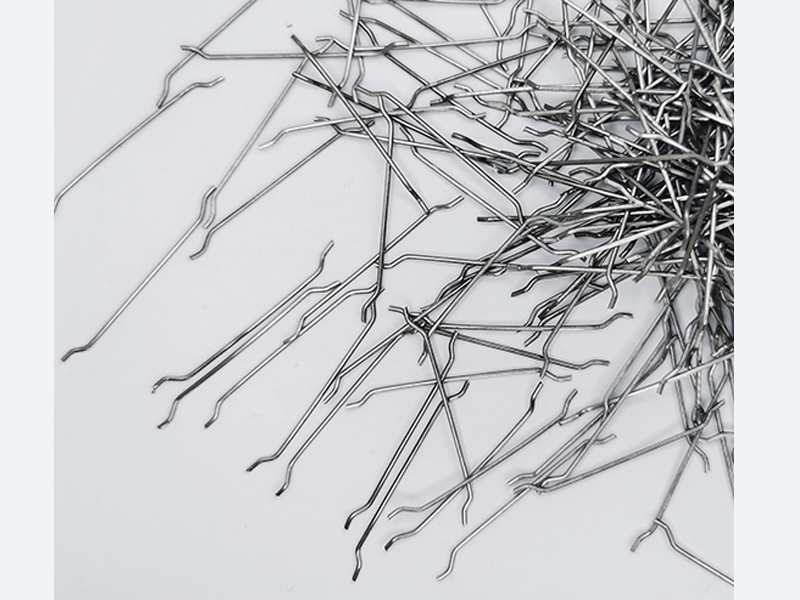
A hooked-end steel fiber is a discrete length of steel reinforcement distributed through concrete. Deformed ends provide mechanical anchorage as a crack opens, allowing fibers that intersect the crack to transfer load across it.

That load transfer is produced by the interaction of the steel fiber, its end geometry, the bond and friction along its embedded length, and the surrounding concrete. The result is a fiber-reinforced concrete composite. It cannot be predicted from the fiber label alone.

Depending on the application and mixture, individual fibers may debond and pull out, hooks may straighten, or fibers may rupture. A well-matched system develops useful post-crack response without treating one mechanism as automatically preferable in every concrete.

Physical characteristics

Read the geometry as a connected system

Length

Fiber length affects embedment and the probability that fibers intercept a crack. It must also suit member thickness, aggregate size, reinforcing congestion, mixer and pump limits, and placement method.

A longer fiber is not automatically better. Excessive length relative to the mixture or component can make dosing, dispersion, pumping, consolidation or surface finish more difficult.

Diameter or equivalent diameter

Diameter is used to characterize round wire fibers. Equivalent diameter provides a comparable measure for fibers whose cross-section is not a simple circle.

Diameter influences aspect ratio and the approximate number of fibers delivered by a given mass. It also affects handling, stiffness of the individual fiber and constructability. It should be read with length and geometry, not alone.

Aspect ratio

Aspect ratio is the fiber length divided by its diameter, or equivalent diameter where applicable. It is a useful physical descriptor, not a complete performance rating.

A higher aspect ratio can influence bond and anchorage potential, while also increasing the need for controlled batching and mixing. Higher is not universally better if the fiber cannot be introduced and dispersed consistently.

Tensile strength

Fiber tensile strength establishes how much tensile stress the steel itself can sustain before rupture. It may be important where strong anchorage and high post-crack demand develop.

Tensile strength alone does not determine FRC performance. A high-strength fiber with unsuitable geometry, inadequate anchorage, poor dispersion or an incompatible concrete matrix does not automatically produce a better composite.

Anchorage and hook geometry

Hook shape, bend configuration and end deformation influence how load transfers from concrete into the fiber. During crack opening, the response may include bond loss, frictional pullout, hook straightening and, in some systems, fiber rupture.

The balance among these mechanisms is product- and concrete-specific. Unsupported quantitative pullout claims should not replace concrete performance testing.

Concrete and placement

Paste volume, aggregate grading, workability, admixtures, mixer energy, addition sequence, pumping and member geometry influence distribution and orientation. The same fiber may perform differently in different mixtures or production systems.

Trials should examine both fresh-concrete practicality and the hardened response required by the specification.

Batching form

Glued or collated fibers versus loose fibers

Collation is a delivery and dispersion strategy. It should not be confused with the hardened reinforcement mechanism.

Why fibers are collated

Water-soluble gluing can hold individual fibers in bundles for packaging and introduction into the mixer. This may help meter and disperse higher-aspect-ratio fibers when the product instructions and mixing process are followed.

What happens in concrete

The bundles are intended to break down during mixing so the individual fibers distribute through the concrete. The glue or bundle is not the source of hardened post-crack performance.

Loose-fiber pathway

Loose fibers can also be introduced successfully when the dosing equipment, addition rate, mixer and mixture support uniform distribution. Loose does not automatically mean easier or harder for every plant.

Product-specific review

Not all glued products, bundle configurations or loose fibers behave identically. Follow the proposed supplier's instructions and confirm the result through production trials and project-relevant tests.

Mass is not performance

Fiber quantity and concrete response are different questions

A dosage in kg/m3 states the mass of fiber added to the concrete. It does not establish that two different products provide equivalent fiber counts, anchorage or post-crack performance.

GeometryLength, diameter, equivalent diameter, aspect ratio and hook shape change the number and behaviour of fibers in the composite.
MaterialSteel grade and tensile strength affect the fiber response but must be considered with anchorage and concrete properties.
DistributionBatching, mixing, orientation and placement determine whether the intended reinforcement is distributed through the member.
PerformanceFirst-peak response, residual flexural response, toughness, crack-width control or structural capacity may be relevant depending on the application.

Performance verification

Check the fiber-reinforced concrete, not only the fiber

FRC is a composite. When post-crack performance matters, the applicable project specification should identify the concrete response and evidence needed for acceptance.

First-peak behaviour

First-peak load or strength describes the beam response near the onset of cracking. It is not the same as the residual capacity measured after the crack has developed.

Residual flexural performance

Residual loads or strengths at specified deflections provide a way to describe post-crack flexural response. Required values come from the project design or specification.

Toughness and energy absorption

The area under a load-deflection response can describe specimen toughness. Its relevance and acceptance basis depend on the application, specimen and test method.

Constructability and durability

Mixing, placing, finish, exposure, crack width and long-term service conditions remain part of the evaluation. A laboratory value does not remove production and construction requirements.

ASTM C1609/C1609M

This test method measures flexural behaviour of FRC beams under third-point loading, including first-peak, peak where applicable, residual loads and strengths at specified deflections, and toughness. It provides a measurement method; it does not choose the required project performance.

Classification alert

ASTM A820 Type I-V is not UCGP 3D-Type or 4D-Type

ASTM A820/A820M is a material specification for steel fibers intended for fiber-reinforced concrete. It classifies fibers by manufacturing form or process: Type I cold-drawn wire, Type II cut sheet, Type III melt-extracted, Type IV mill-cut, and Type V modified cold-drawn wire.

Do not combine the naming systems.

3D-Type and 4D-Type on UCGP are commercial product-family descriptions. They are not ASTM A820 fiber classifications. A quoted product's ASTM type, dimensions, tensile properties and conformance documentation must be confirmed for that specific inquiry.

ASTM A820 helps describe and verify the steel fiber as a material. It does not by itself establish the required dosage, concrete mixture, structural design or post-crack performance for a project.

UCGP pathways

Current hooked-end steel fiber routes

Regular Supply

3D-Type Hooked-End

A current hooked-end steel fiber pathway for concrete reinforcement. Exact dimensions, tensile properties, packaging and documentation are confirmed per quotation.

Review 3D-Type hooked-end steel fiber
Regular Supply

4D-Type Glued / Hooked-End

A collated hooked-end pathway intended for controlled batching and dispersion. Product-specific mixing instructions and technical data apply.

Review 4D-Type glued hooked-end steel fiber
Available on Request

Other Grades / Geometries

Other hooked-end grades and geometries can be reviewed where a project specification calls for a different product profile or documentation set.

Review other hooked-end steel fibers

Buyer checklist

Information to include in a steel fiber specification or RFQ

Provide the items that are known. If the product details are not yet defined, send the project specification and application basis for review.

  • Concrete application and member type
  • Project specification and responsible design basis
  • Fiber geometry or commercial type if specified
  • Fiber length
  • Diameter or equivalent diameter
  • Aspect ratio
  • Tensile-strength requirement if specified
  • Applicable ASTM or project requirements
  • Required residual-performance criteria and test method
  • Concrete mixture, aggregate and placement context
  • Estimated quantity and packaging requirement
  • Delivery destination and batching location
  • Required schedule
  • Product, conformance, safety or test documentation required
Technical responsibility

UCGP supports product, specification, documentation and quotation review. Structural design, reinforcement substitution, concrete mixture design, fiber dosage, testing, acceptance and project approval remain with the responsible engineer, producer, laboratory, specification and applicable authority.

References and further reading

Links lead to official standard or guidance pages. UCGP does not reproduce or claim ownership of paid standards.

Review a hooked-end steel fiber requirement

Share the application, specification, fiber geometry if known, required concrete performance, quantity, destination and schedule.

Request a Fiber Quote