
First-peak load and strength
These describe the flexural response at the first identifiable peak near the onset of cracking. They characterize a different stage of behaviour than post-crack residual values.
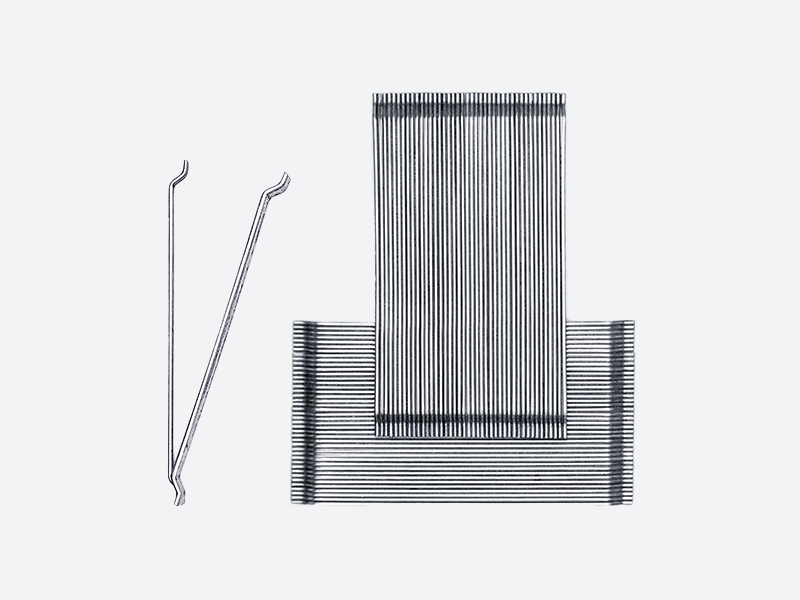
Standards guide
A steel fiber product, the delivered fiber-reinforced concrete and the hardened FRC performance may be addressed by different standards. ASTM A820/A820M, C1116/C1116M and C1609/C1609M are related, but they are not interchangeable.
Three different questions
A project can identify a material standard for the steel fiber, a specification for the fiber-reinforced concrete, and a test method for the hardened FRC response.
ASTM A820/A820M addresses steel fibers intended for fiber-reinforced concrete. ASTM C1116/C1116M addresses fiber-reinforced concrete supplied to a purchaser. ASTM C1609/C1609M measures flexural performance of hardened FRC beams.
None of the three independently establishes the complete structural design, required dosage, acceptance value or suitability of one product for every application. The project documents must state which standards and performance criteria apply.
Quick comparison
| Standard | Applies to | Addresses | Does not establish by itself | Typical buyer question |
|---|---|---|---|---|
| ASTM A820/A820M-22 | Steel fibers intended for FRC | Fiber types, dimensions and tolerances, minimum physical properties, testing and conformance-related requirements | Concrete dosage, structural design, delivered-concrete requirements or required residual performance | What steel-fiber material classification and documentation does the project require? |
| ASTM C1116/C1116M-23 | Fiber-reinforced concrete supplied to a purchaser | FRC categories and applicable ordering, production, delivery, mixing, sampling, acceptance and property requirements | Structural design or proof that one fiber or dosage meets a project's hardened-performance target | How should the FRC be ordered, produced and delivered for this project? |
| ASTM C1609/C1609M-24 | Hardened FRC beam specimens | Third-point flexural testing, first-peak and peak response, residual loads/strengths and toughness | The residual strength or toughness that the project must achieve | How will the specified FRC flexural response be measured and reported? |
Material specification
ASTM A820/A820M is the Standard Specification for Steel Fibers for Fiber-Reinforced Concrete. It defines minimum requirements for steel fibers and provides methods for checking relevant dimensions, tolerances and physical properties.
At a high level, the standard addresses nominal and measured length, diameter or equivalent diameter, aspect ratio, tensile and bend testing, permissible dimensional variation, inspection, rejection, certification and packaging concepts. The exact project requirement should identify the edition and any purchase-order provisions that apply.
| ASTM type | High-level manufacturing description | Procurement note |
|---|---|---|
| Type I | Cold-drawn wire | Confirm the quoted product's type, geometry, dimensions and supporting documentation. |
| Type II | Cut sheet | Classification describes manufacturing form, not a universal concrete performance level. |
| Type III | Melt-extracted | Application suitability still depends on product and FRC performance requirements. |
| Type IV | Mill-cut | Do not infer equivalence to another type from dosage alone. |
| Type V | Modified cold-drawn wire | Project and purchase documents should define the required product evidence. |
3D-Type and 4D-Type on UCGP are commercial product-family descriptions. They are not ASTM A820 Type III or Type IV classifications. The two naming systems are not interchangeable.
UCGP does not state that every steel fiber automatically conforms to ASTM A820/A820M. Conformance and supporting documentation must be confirmed for the specific fiber quoted for the project.
Concrete specification
This document applies to the FRC supplied to the purchaser, not only to the separate fiber material.
C1116/C1116M covers applicable ordering and production requirements for FRC, including mixing and delivery considerations, and addresses relevant fresh-concrete properties and acceptance. Its scope also includes certain precast, zero-slump and dry-mix shotcrete situations under stated conditions.
It does not substitute for structural design, placement, consolidation, curing or protection requirements after delivery. It also does not establish that every Type I, II, III or IV FRC mixture will provide the same hardened-concrete response.
Performance test method
C1609/C1609M evaluates a simply supported FRC beam under third-point loading using controlled test equipment and a measured load-deflection response.
These describe the flexural response at the first identifiable peak near the onset of cracking. They characterize a different stage of behaviour than post-crack residual values.
The overall peak may occur at or after first peak depending on the FRC response. The test reports the relevant loads and calculated strengths defined by the method.
Residual values are measured at specified beam deflections and describe the remaining flexural load-carrying response after cracking has developed.
The recorded curve shows how the specimen carries load as deflection increases. Fiber type, dosage, distribution, orientation, matrix and specimen geometry can influence the result.
The area under the load-deflection curve to a defined deflection represents specimen energy absorption. It is test- and specimen-dependent, not a universal structural energy value.
C1609 provides a way to measure and report the response. It does not tell the buyer what residual strength, toughness or deflection criterion the project needs. Those values come from the responsible design and specification.
When a project cites C1609, the specification should also identify the required specimen, test age, sampling frequency, target deflection points, acceptance values and reporting basis.
Illustrative workflow
This sequence is a procurement example, not a universal code requirement. The responsible design and project documents control.
The project defines the application, structural or nonstructural role, applicable standards, concrete properties, performance values, testing and acceptance criteria.
Where specified, the proposed steel fiber is checked against ASTM A820/A820M requirements, the required type, dimensions, tensile properties and project documentation.
ASTM C1116/C1116M may provide applicable requirements for ordering, producing, mixing and delivering the selected fiber-reinforced concrete.
Where required, ASTM C1609/C1609M testing measures first-peak, residual and toughness-related response of the qualified FRC mixture.
The engineer, specification and applicable authority determine whether the documented material and measured concrete response satisfy the project.
Ordering and documentation
State the exact standard and edition. Avoid requests such as "ASTM steel fiber" without identifying the material classification, concrete requirements or performance evidence expected.
Available documentation is confirmed for the specific product and inquiry. UCGP does not imply that every certificate, test report or standard-conformance document is available for every sourcing pathway.
Common procurement errors
Clear documents reduce substitutions, incomplete quotations and test results that cannot be compared to the project criteria.
UCGP supports product, specification, documentation and quotation review. Structural design, reinforcement substitution, concrete mixture design, fiber dosage, testing, acceptance and project approval remain with the responsible engineer, producer, laboratory, specification and applicable authority.
Official standards and guidance
These links point to official publisher pages. This guide paraphrases high-level scope and procurement concepts; it does not reproduce the paid standards.
Related UCGP resources
Share the application, exact standard and edition, product requirements, concrete performance criteria, quantity, destination and schedule.