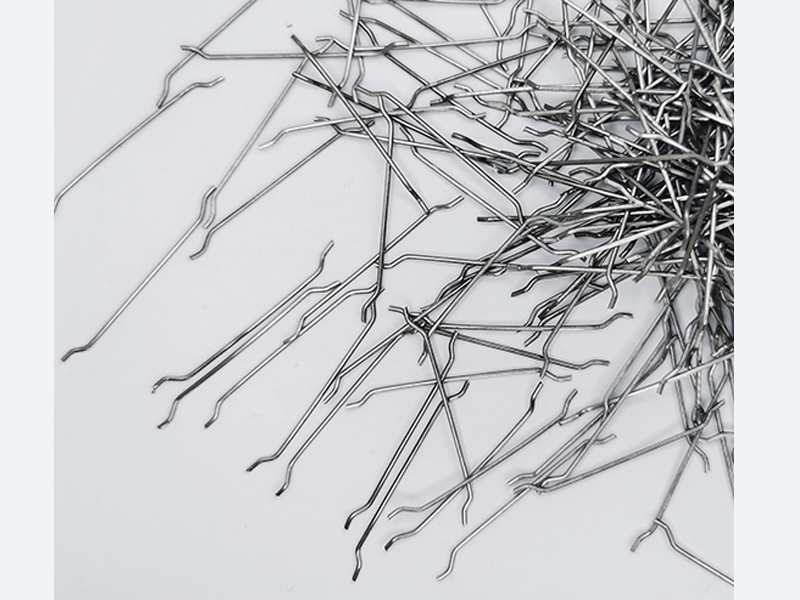
Length
Fiber length affects embedment and the probability that fibers intercept a crack. It must also suit member thickness, aggregate size, reinforcing congestion, mixer and pump limits, and placement method.
A longer fiber is not automatically better. Excessive length relative to the mixture or component can make dosing, dispersion, pumping, consolidation or surface finish more difficult.
Diameter or equivalent diameter
Diameter is used to characterize round wire fibers. Equivalent diameter provides a comparable measure for fibers whose cross-section is not a simple circle.
Diameter influences aspect ratio and the approximate number of fibers delivered by a given mass. It also affects handling, stiffness of the individual fiber and constructability. It should be read with length and geometry, not alone.
Aspect ratio
Aspect ratio is the fiber length divided by its diameter, or equivalent diameter where applicable. It is a useful physical descriptor, not a complete performance rating.
A higher aspect ratio can influence bond and anchorage potential, while also increasing the need for controlled batching and mixing. Higher is not universally better if the fiber cannot be introduced and dispersed consistently.
Tensile strength
Fiber tensile strength establishes how much tensile stress the steel itself can sustain before rupture. It may be important where strong anchorage and high post-crack demand develop.
Tensile strength alone does not determine FRC performance. A high-strength fiber with unsuitable geometry, inadequate anchorage, poor dispersion or an incompatible concrete matrix does not automatically produce a better composite.
Anchorage and hook geometry
Hook shape, bend configuration and end deformation influence how load transfers from concrete into the fiber. During crack opening, the response may include bond loss, frictional pullout, hook straightening and, in some systems, fiber rupture.
The balance among these mechanisms is product- and concrete-specific. Unsupported quantitative pullout claims should not replace concrete performance testing.
Concrete and placement
Paste volume, aggregate grading, workability, admixtures, mixer energy, addition sequence, pumping and member geometry influence distribution and orientation. The same fiber may perform differently in different mixtures or production systems.
Trials should examine both fresh-concrete practicality and the hardened response required by the specification.